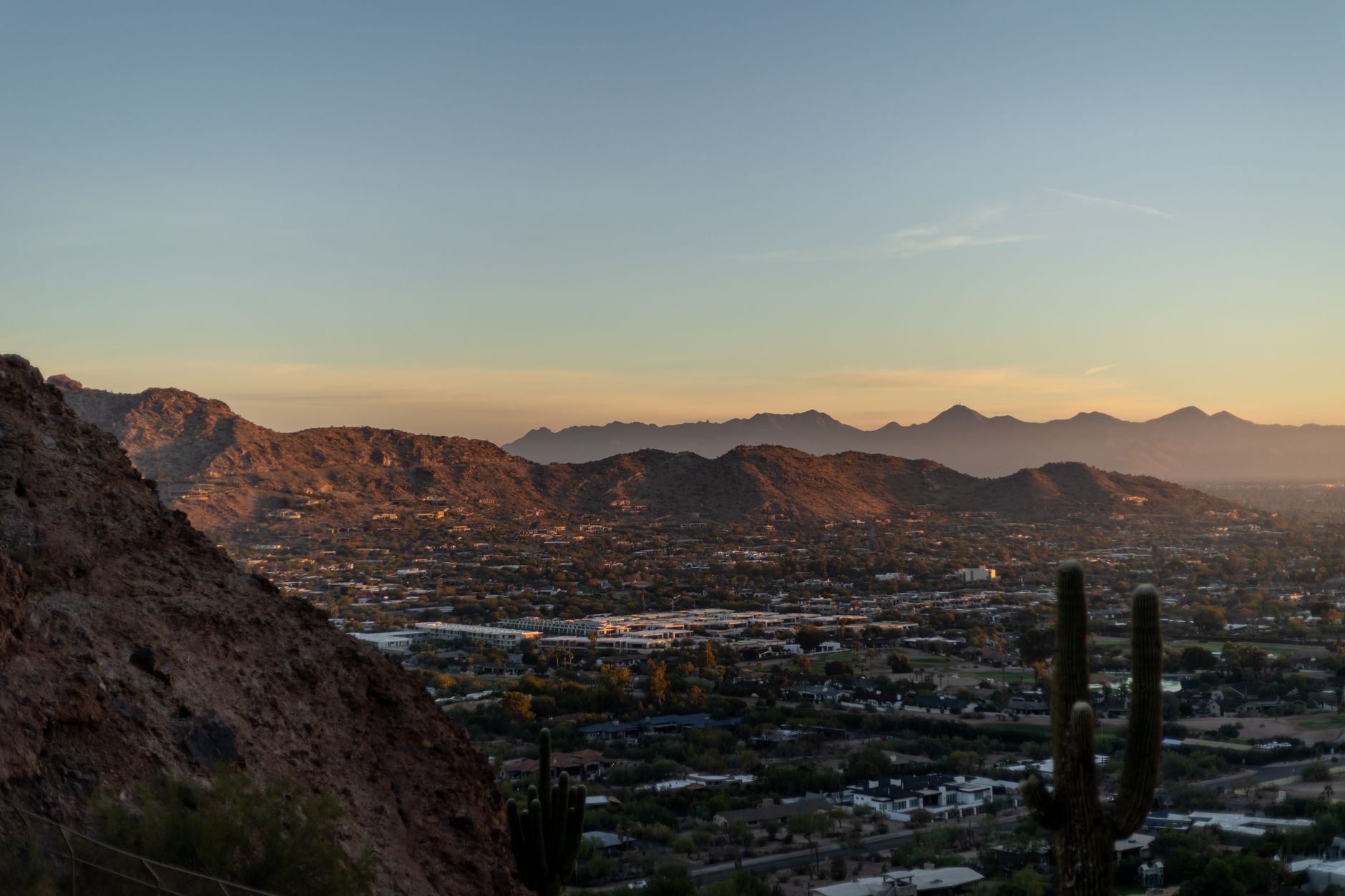
Phoenix and Las Vegas are the two cities people compare when they're looking for Sun Belt affordability, warm weather, and a no-income-tax advantage. Both are growing fast. Both have desert climates. Both have had significant population growth from California transplants. Here's the honest comparison on price, neighborhoods, jobs, and what each city actually delivers for residents.
| Phoenix (metro) | Las Vegas (metro) | |
|---|---|---|
| WYLT city verdict | Think twice (85016) | 4 of 5 Good for now |
| Median home price (good areas) | $400K–$600K (suburbs) | $345K–$612K (Summerlin) |
| State income tax | 2.5% flat (Arizona) | None (Nevada) |
| Water risk | Moderate — Colorado River dependent | Higher — Lake Mead dependent |
| Summer heat | Severe (110°F+ days) | Severe (115°F+ days) |
| Traffic | Heavy freeway system | More manageable outside Strip |
| Job market depth | Deep — tech, finance, healthcare | Smaller — tourism, logistics, growing tech |
| Airport | PHX (major Southwest hub) | LAS (major Southwest hub) |
| Professional sports | Cardinals, Suns, Diamondbacks, Coyotes | Raiders, Golden Knights, A's |
The data contrast: Las Vegas suburbs outperform Phoenix in WYLT's reviews
This surprises most people. Las Vegas has four "Good for now" verdicts (Summerlin North and South, Spring Valley, Northwest Las Vegas) versus Phoenix's single reviewed neighborhood (85016, Camelback East) earning "Think twice." This reflects the nature of what we've reviewed — Las Vegas's suburban ring is genuinely strong — rather than Phoenix being worse than Las Vegas overall. The Phoenix metro has excellent suburbs (Scottsdale, Gilbert, Chandler, Tempe) that would likely earn strong verdicts. But the available data favors Las Vegas in this direct comparison.
Price — Las Vegas wins in the suburban comparison
Las Vegas's master-planned suburbs (Summerlin) run $402K–$612K for "Good for now" neighborhoods. Spring Valley comes in at $345K for the same verdict. Phoenix's best suburban options (Scottsdale, Chandler, Gilbert) tend to run $450K–$700K+ for comparable quality. Henderson (Las Vegas) competes directly with Chandler and Gilbert at similar price points with similar safety profiles.
Phoenix has the deeper discount opportunity in lower-quality areas — you can find homes in the $200K–$300K range in parts of the Valley — but those areas require real safety diligence that Las Vegas's 89147 and 89134 don't.
Income tax — Nevada wins, clearly
Nevada has no state income tax. Arizona has a 2.5% flat income tax (significantly lower than its historical progressive rates, but still real). For a $120,000 household income, this is approximately $3,000/year — not a lifestyle-changing number, but meaningful over time. For higher earners (over $200K), it compounds to $5,000+ annually. It's a real advantage for Las Vegas.
Jobs — Phoenix has more depth
Phoenix's job market is substantially larger and more diversified than Las Vegas's. The city has attracted major tech campuses (Intel, TSMC's semiconductor fab, Apple), financial services (American Express, JPMorgan, Charles Schwab), and healthcare (Banner Health, Mayo Clinic). It's a tier-two tech market with genuine momentum.
Las Vegas's economy is historically anchored in tourism and hospitality, with a growing logistics sector and a nascent tech scene. The Raiders' move and recent sports expansion (NHL, MLB) have accelerated amenity development, but the employment depth for knowledge workers is narrower than Phoenix's.

Heat — both cities are extreme
Neither city lets you off the hook here. Phoenix averages 110+ days above 100°F; Las Vegas averages 137 days above 100°F and regularly hits 115°F+. Las Vegas's lower humidity makes extreme heat slightly more tolerable, but both cities require full car dependency in summer peak hours, high utility bills for constant air conditioning, and realistic expectations about outdoor activity from June through September. Don't move to either city expecting a moderate climate.
Water — a long-term risk for both
Both Phoenix and Las Vegas depend heavily on the Colorado River and its reservoir system (Lake Mead for Las Vegas, Lake Powell/CAP for Phoenix). Drought conditions over the past decade have reduced reservoir levels and prompted mandatory water use restrictions. This is a real long-term risk that neither city has fully resolved, and it's a factor worth considering for buyers planning multi-decade ownership.
Who should choose Phoenix
- Tech, semiconductor, and finance professionals where Phoenix's job market has specific depth
- Buyers who want the broadest range of suburban options — Scottsdale, Chandler, Gilbert, Tempe, Peoria all have distinct characters
- Sports fans — four major professional leagues vs Las Vegas's three
- People who prioritize proximity to Sedona, Flagstaff, and the Grand Canyon for outdoor access
Who should choose Las Vegas
- Remote workers and retirees for whom the income tax savings is meaningful without needing a local job market
- Buyers who want to maximize the Summerlin or Henderson experience — master-planned suburbs at slightly lower prices than Phoenix's best equivalents
- Anyone who flies frequently — LAS has excellent direct flight coverage to the West Coast and Southwest
- Entertainment-oriented households who want concerts, boxing, F1, and pro sports within 20 minutes
Summerlin South LV → | Summerlin North LV → | Spring Valley LV → | Phoenix Camelback →