Baltimore's murder rate consistently ranks among the highest of any major American city. That is not an exaggeration designed to scare people — it is a documented fact that the city's own officials acknowledge. In some years, Baltimore's per-capita homicide rate exceeds cities twice its size.
And yet: four of the seven Baltimore ZIP codes in WYLT's dataset earn a "Good for now" verdict. Median home prices that would make coastal buyers do a double-take — $221,000 to $480,000 for genuine urban neighborhoods. A 45-minute MARC commute to Washington DC. Johns Hopkins University and Medical Center anchoring the city's economic identity. A food scene that has no business being as good as it is.
Baltimore is not a city you move to without doing your homework. It is also not a city you rule out based on the aggregate statistic without doing your homework. The citywide average is one of the most misleading numbers in American real estate.
Understanding Baltimore's crime geography
Baltimore's violent crime — including its homicide rate — is concentrated in specific corridors of the city. West Baltimore (particularly the neighborhoods made famous by The Wire) and parts of East Baltimore have violent crime rates that are genuinely extreme by any standard. These are areas where the crime statistics apply at full force.
The neighborhoods that attract relocating professionals and young families — Roland Park, Hampden, Charles Village, Canton, Fells Point — are geographically and statistically different. They still sit inside Baltimore City limits and carry the city's aggregate crime number whenever anyone Googles "Baltimore crime." The lived experience is considerably different.
Property crime is more evenly distributed. Car break-ins, porch theft, and catalytic converter theft happen across the city, including in better neighborhoods. This is a genuine quality-of-life issue that Baltimore residents manage through parking choices, home security, and neighborhood awareness — not something you can fully escape by choosing the right ZIP code.
Why the DC connection changes the math
Baltimore sits 40 miles northeast of Washington DC. The MARC Penn Line runs directly from Baltimore's Penn Station to Union Station in downtown DC — the commute takes 45 minutes to an hour, and monthly passes run around $200. Amtrak takes 30 minutes.
For federal workers, government contractors, and DC-based professionals who can't afford DC or Northern Virginia housing, Baltimore has become a legitimate option. You can buy a renovated row house in Hampden for $262,000 and commute to a $180,000 federal salary in DC. That math doesn't exist anywhere else in the Mid-Atlantic corridor.
This DC premium has driven real appreciation in Baltimore's best neighborhoods. Roland Park, Charles Village, and Hampden have seen consistent demand from DC-adjacent buyers who want more space and a genuine neighborhood feel at prices that have become impossible in the DC metro.
What WYLT's data shows by neighborhood
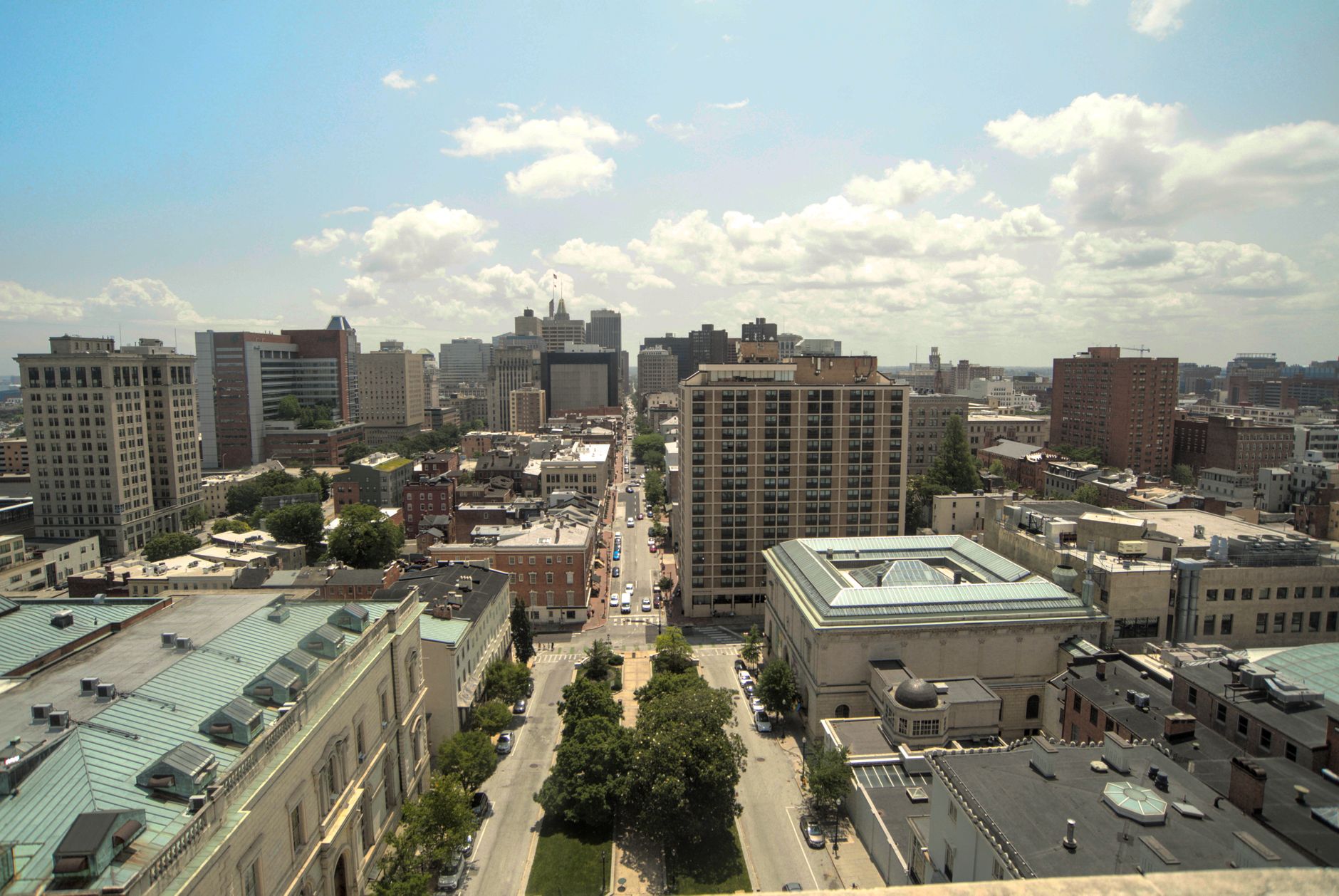
21210 — Roland Park / North Baltimore: Good for now ✅
Roland Park is Baltimore's most affluent established neighborhood and its clearest "Good for now" verdict. Median home at $480,000, school rating of 7.3, and a household income of $114K that reflects the demographics — doctors, lawyers, Hopkins faculty. The walk score of 39 means you need a car, but the neighborhood's tree-lined streets and access to Roland Park shopping make it the kind of quiet, well-maintained urban enclave that justifies the price.
If you're coming from suburban DC and want Baltimore's most friction-free entry point, this is it.
21211 — Hampden: Good for now ✅
Hampden is the neighborhood that surprises Baltimore skeptics the most. The "Hon" culture, the 36th Street "Avenue," the indie restaurants and coffee shops — it has a genuine character that's hard to manufacture. Median home at $262,000 with a walk score of 76 makes this the best value-for-walkability proposition in WYLT's Baltimore dataset. Schools rate 7.2.
Crime is higher here than Roland Park but significantly below the city average. Hampden attracts the creative class, Hopkins grad students, and young professionals who want urban living without paying Fells Point premiums for less space.
21218 — Charles Village / Waverly: Good for now ✅
Charles Village sits at the eastern edge of Johns Hopkins's main campus and is the obvious choice for anyone affiliated with the university. Median home at $221,000 — the most affordable "Good for now" verdict in WYLT's Baltimore set. Walk score of 69, 9-minute commute to downtown, schools at 7.2.
The neighborhood has a distinctly academic feel — rows of Victorian homes, coffee shops built for laptop work, a bookstore culture that persists. Crime is present and real, but the area benefits from Hopkins's ongoing investment in neighborhood security and amenities.
21224 — Canton / Highlandtown: Good for now ✅
Canton is Baltimore's young professional row house neighborhood — the Fells Point adjacent area with waterfront access, a dense bar and restaurant corridor along O'Donnell Street, and housing prices ($260,000 median) that still feel like a deal compared to DC equivalents. Walk score of 0 in the WYLT data is misleading — Canton Square and the O'Donnell corridor are genuinely walkable by Baltimore standards.
Highlandtown, immediately to the west, is the value play within the 21224 ZIP — more working-class character, more authentic Baltimore, and another $30,000–$60,000 cheaper than Canton proper.
21201 — Downtown Baltimore: Think twice ⚠️
Downtown has the walkability (score: 70) and the proximity to everything, but the cost-to-quality equation is off. At $252,000 median, you'd expect a cleaner "Good for now" — but crime in downtown Baltimore is elevated in ways that affect daily quality of life more than the numbers alone convey. The neighborhood has struggled to maintain the retail and restaurant density that would make the density worth it. Daytime energy, rough evenings.
21230 — South Baltimore / Federal Hill: Think twice ⚠️
Federal Hill is one of Baltimore's most photogenic neighborhoods — the views of the Inner Harbor from Federal Hill Park are genuinely stunning. But the "Think twice" verdict reflects a real problem that most listings don't disclose: flood risk. The 21230 ZIP includes AE flood zone designations that mean extra insurance, potential mitigation costs, and climate-change exposure in a city that sits at sea level on the Chesapeake Bay. At $323,000 median, you're paying for the view and inheriting the water risk.
21231 — Fells Point / Harbor East: Think twice ⚠️
Fells Point has the best walk score in the dataset (79) and a lively waterfront bar scene. It also has the highest median home price in WYLT's Baltimore set at $331,000 — and crime rates that don't match the price tag. For the money, Hampden or Canton deliver more livability. Fells Point works better as a place to go out than a place to settle in.
The Hopkins effect on livability
Johns Hopkins University and the Johns Hopkins Health System together employ roughly 50,000 people in Baltimore. They are the city's largest private employer by a significant margin and one of the most important anchor institutions in any American city.
Hopkins's presence does three things for Baltimore's best neighborhoods: it provides stable employment that doesn't leave when the economy turns; it drives demand for housing in Charles Village, Hampden, and Roland Park regardless of the city's overall reputation; and it funds neighborhood safety initiatives, security cameras, and community programs that have genuinely improved outcomes in the areas immediately surrounding the Homewood campus.
If you're in medicine, research, or higher education, Baltimore-for-Hopkins is a coherent relocation thesis. The neighborhood dynamics make sense when you understand that ecosystem.
Cost of living: the genuine advantage
Baltimore's median home prices look like typos to anyone coming from the DC suburbs. $221,000 for a renovated row house in an urban neighborhood with a 9-minute downtown commute. $262,000 in Hampden. $260,000 in Canton.
Maryland's income tax is real (top rate 5.75% state + 3.2% Baltimore City resident surcharge). Property taxes in Baltimore City are among the highest in the state. But the housing discount is so large that the effective cost of ownership is dramatically below anything comparable in Northern Virginia or Montgomery County.
The caveat: homeownership in Baltimore requires either cash reserves or risk tolerance for maintenance surprises. The city's row house stock is old — most homes were built before 1950, and many have deferred maintenance that doesn't show up in the listing photos. Budget 1.5–2% of home value annually for maintenance, not the 1% rule applied elsewhere.
The honest verdict
Baltimore is a city for people who do their research. The aggregate crime statistic is bad and partially real — the violence in west and east Baltimore is not invented, and the city has structural challenges it has not solved.
The neighborhoods in WYLT's "Good for now" column are genuinely livable in a way that the aggregate number does not capture. Hampden, Charles Village, Canton, and Roland Park attract and retain people who have lived there for decades — not because they're overlooking something, but because they've done the same neighborhood-level research the headlines don't provide.
If you're considering Baltimore, the path is simple: come with a specific neighborhood in mind, spend time there across different times of day and week, talk to residents, and use the ZIP code-level reports below rather than the citywide statistics. That's how Baltimore becomes legible — and for the right person, genuinely worth it.