The song was already written before you decided to move here.
It goes like this: tired of the cold, tired of the taxes, tired of the cost of everything, tired of the commute that takes an hour to go eleven miles. You visited Nashville on a long weekend in October when the weather was 72 degrees and perfect and Broadway was loud and alive and the brisket at some place you found by accident was the best thing you'd eaten in three years. You flew home on a Sunday night and sat in traffic on whatever highway connects your life to your office and thought — why am I still here?
That song has been number one in Nashville for about fifteen years running. The city knows every word.
The verse everyone gets right

Nashville is genuinely good and the reasons people move here are genuinely real. Start with that because it matters.
No state income tax. For a household earning $180,000 moving from New Jersey or Illinois or California the annual tax savings run $8,000 to $18,000 depending on your situation. That is not nothing. That is a car payment, a college savings contribution, a vacation, a renovation — real money that changes what your life can look like month to month.
The food scene arrived. This is not a small thing. Nashville in 2026 has restaurants that would hold their own in any American city — not just for hot chicken, which is legitimately excellent and worth understanding as a genuine culinary tradition rather than a tourist novelty, but across every category. The dining corridors along 12th Avenue South, Germantown, and East Nashville have a depth and independence that cities twice Nashville's size would be proud of.
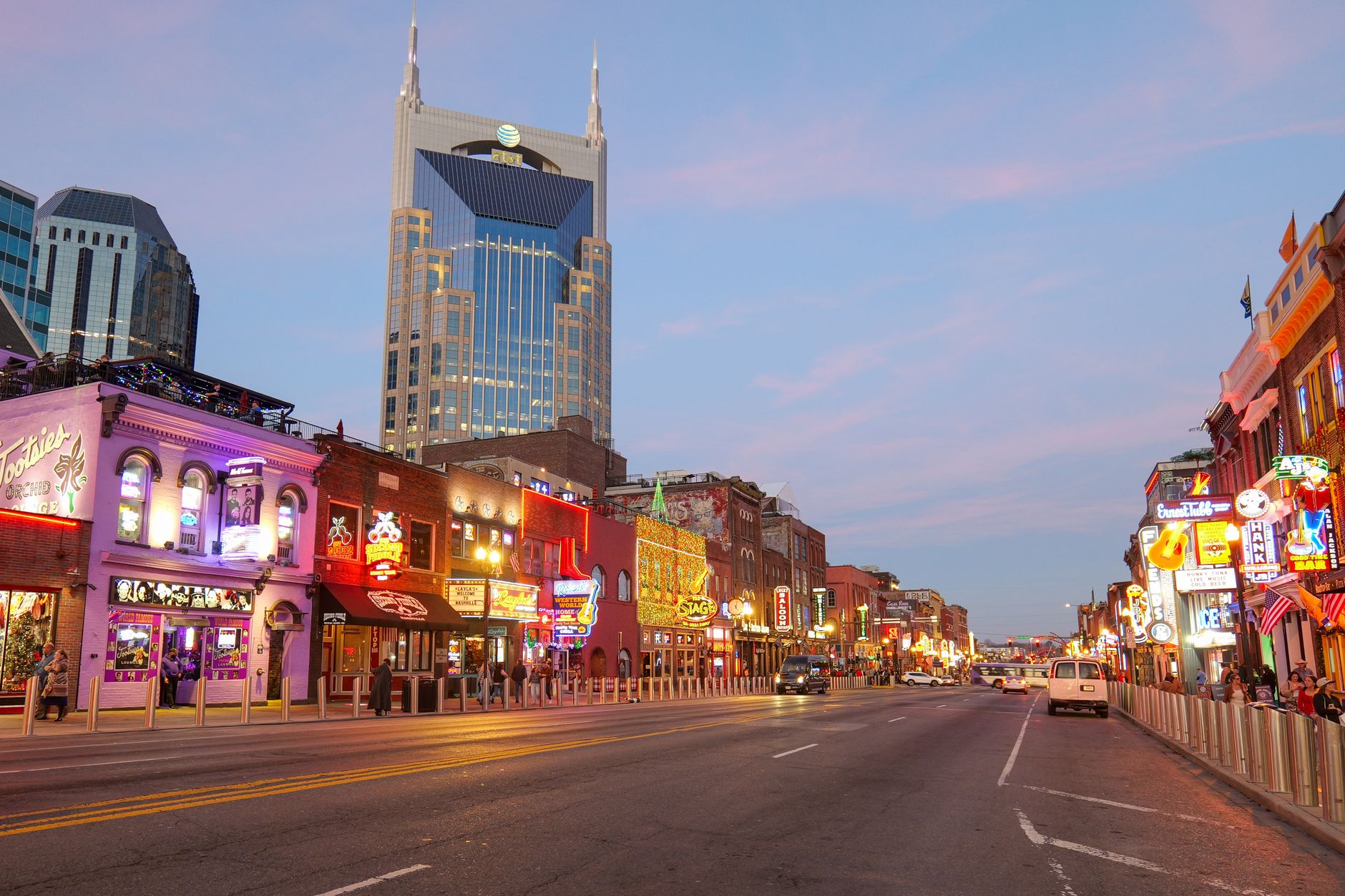
The music is real. Not just the Broadway honky-tonks that exist primarily for the bachelorette industrial complex — though those have their own honest place in the city's economy — but the actual music. The Ryman Auditorium. The Bluebird Cafe where songwriters play in the round and the person three tables over might be the one who wrote a song you've known by heart for twenty years. The Station Inn for bluegrass on a Tuesday night. The living tradition of American music running through the city like a current you can feel if you know where to stand.
Vanderbilt, Belmont, Lipscomb, Fisk — the university ecosystem gives Nashville an intellectual and creative energy that many Sun Belt cities of comparable size don't have. The healthcare industry anchored by HCA Healthcare, Vanderbilt University Medical Center, and a growing constellation of health tech companies has built a professional employment base that extends well beyond the music and tourism economy.
The bridge — where the song gets honest
Every good Nashville song has a bridge. The moment where the melody shifts and the lyric says something true that the verse wasn't ready to say.
Here is Nashville's bridge.
The traffic. Nashville was not built for the city it became. The road infrastructure of a mid-sized Southern city is now carrying the load of a major metro and the gap is visible every morning on I-65 and I-24 and Briley Parkway. The commute you imagined — easier, faster, more humane than whatever you left — is real at 11am on a Wednesday. At 8am on a Tuesday it is a different conversation. Test your actual commute at your actual time before you commit to any specific neighborhood.
The price. Nashville's affordability story has been rewritten significantly by the migration wave that the October-weekend version of the city inspired in thousands of people simultaneously. Median home prices in desirable Nashville neighborhoods — 12 South, Germantown, East Nashville, Sylvan Park — run $550,000 to $850,000. The suburbs that absorbed the overflow — Franklin, Brentwood, Nolensville — run $500,000 to $750,000 for most family-sized homes. Nashville is still less expensive than coastal markets. It is no longer the dramatic value it was in 2018 and it is important to go in knowing that.
The bachelorette economy. Nashville hosts more bachelorette parties per capita than any city in America and the infrastructure built to serve them — pedal taverns, party buses, rooftop bars, Broadway honky-tonks that operate from 10am to 3am — is concentrated in ways that significantly affect the livability of certain neighborhoods at certain times. If you are considering a home within earshot of Broadway or the surrounding blocks, visit on a Saturday night before you make any decisions. What you hear will be informative.
The transit. Nashville has essentially no public transit for practical daily use. You will own a car. You will drive it everywhere. You will spend time in it every day in ways that feel unfamiliar if you're coming from a transit-connected city. Budget for two vehicles per household and the full cost of operating them.
Nashville neighborhood reports — check before you commit
Every neighborhood in Nashville has a different personality, price point, and commute reality. The WYLT data for specific zip codes gives you flood risk, school ratings, price trends, and an honest verdict before you spend a weekend driving around:
- East Nashville (37206) — The creative hub. Higher prices than it was, still more character per dollar than almost anywhere in the city.
- Germantown / SoBro (37203) — Urban core, walkable, close to the action. Know what you're buying into noise-wise.
- 12 South / Berry Hill (37204) — Family-friendly, dining corridor, consistently in demand. Prices reflect it.
- Franklin (37064) — Top-rated schools, historic downtown, and the commute into Nashville you'll want to test at 8am before you buy.
- Brentwood (37027) — Highest-rated schools in the metro, suburban infrastructure, prices to match.
The chorus — what makes people stay
Ask someone who has lived in Nashville for five years what they love about it and the answers are remarkably consistent. The community. The warmth of the people — genuine Southern hospitality that is not a performance but a cultural inheritance that shows up in small daily interactions that accumulate into something real. The feeling of being in a city that is still becoming something — that has energy and momentum and a sense of possibility that older more settled cities sometimes lose.
The October weather that brought you here in the first place. It is still that good. November through March is mild in ways that earn genuine appreciation from anyone who has spent winters somewhere colder. The city lights up around the holidays in a way that feels warm rather than commercial.
And the music. Always the music. Even residents who aren't music people find themselves at the Ryman or the Bluebird or the Station Inn eventually and come home having understood something new about the city they chose.
The outro
Nashville will not be perfect for everyone. The traffic will frustrate you. The prices will require honest budgeting. The bachelorette weekends will occasionally test your patience if you live near the action.
But for the right person — and there are a lot of right people for this city — Nashville delivers something genuine. A warm city with a real identity and a soundtrack that has been playing for a hundred years and shows no signs of stopping.
The song was already written. The question is whether you're ready to move to where it lives.
Research any Nashville zip code free at wouldyoulivethere.com — commute times, price trends, school ratings, flood risk, and an honest verdict before you decide.