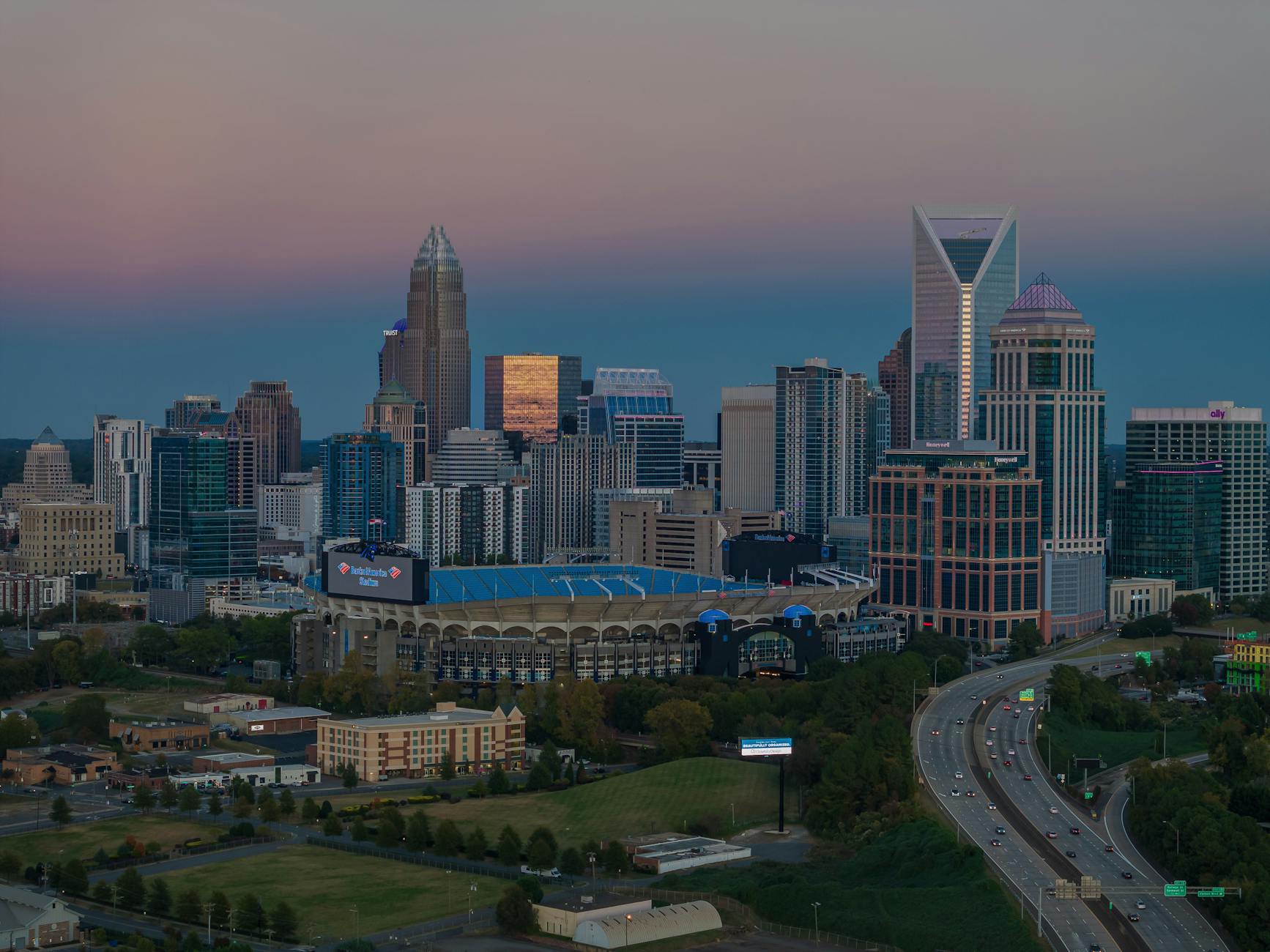
Charlotte is the largest city in the Carolinas, the second-largest banking center in the United States after New York, and one of the fastest-growing metros in the South. It added over 100,000 people between 2020 and 2024. The question isn't whether Charlotte is growing — it obviously is. The question is whether it's actually good to live in, for your specific priorities, and what the data says.
Here's the honest answer.
WYLT's verdict on Charlotte's neighborhoods
The striking thing about Charlotte's neighborhood data is the consistency: most ZIP codes earn "Good for now" — meaning the fundamentals are solid across a wide range of the city. There are no "Settle here" outliers at the top, but there are also very few hard failures. Charlotte is a broadly livable city without a single transcendent neighborhood.
| Neighborhood | Verdict | Median Home Price | Walk Score | School Rating |
|---|---|---|---|---|
| Uptown / 4th Ward | Good for now | $392,300 | 82/100 | 7.3/10 |
| South End / Dilworth | Good for now | $736,900 | 70/100 | 7.4/10 |
| Myers Park | Good for now | $532,300 | 19/100 | 7.5/10 |
| Ballantyne | Good for now | $460,500 | 17/100 | 8.6/10 |
| Plaza Midwood / NoDa | Good for now | $375,200 | 22/100 | 7.3/10 |

The case for Charlotte
The job market is one of the strongest in the South
Bank of America and Wells Fargo headquarter here. The Carolinas Heathcare System and Atrium Health make it a major medical employment hub. Lowe's, Truist, and a growing tech sector round out an employment base that is more diversified than most cities its size. The financial services concentration means white-collar professional salaries are competitive in a cost structure that's still well below coastal cities. That math — good salaries, manageable housing — is the core of Charlotte's relocation case.
Ballantyne has the best schools on this list
Ballantyne (28277) in south Charlotte has a school rating of 8.6/10 — the highest in the city for neighborhoods we track — at a median home price of $460,500. For families where school quality is the primary filter, Ballantyne consistently outperforms the rest of Charlotte. It's car-dependent (Walk Score 17) and feels more suburban than urban, but the school data is hard to argue with.
South End has genuine walkability and restaurant density
South End (28203) along the light rail corridor is the most urban experience Charlotte offers — Walk Score 70, a brewery district, converted warehouses with independent restaurants, and direct light rail access to Uptown. At $736,900 median it's expensive, but it's where people who want walkable urban Charlotte life end up. It's also the neighborhood with the most visible appreciation trajectory as the light rail expansion continues.
Plaza Midwood is the value play with personality
Plaza Midwood (28205) is Charlotte's most characterful neighborhood at its most affordable price point — $375,200 median with independent restaurants, bars, the 7th Street Public Market, and a diverse longtime residential community that predates the city's recent growth surge. It's where Charlotte feels less like a boomtown and more like an actual place.
The honest concerns
Charlotte is a car city
Except for South End's light rail corridor and parts of Uptown, Charlotte requires a car for virtually all daily activity. Walk Scores across most of the city are in the teens and twenties. The road network is built for suburban sprawl and the public transit system, while improving, is not yet at the level where it changes daily life for most residents. Budget for two vehicles as a two-adult household.
The "urban" experience is limited compared to peer cities
Charlotte is a big city by population that often feels like a medium-sized one by urban density. The downtown core is pleasant but compact, the restaurant scene is growing but thin on world-class options compared to Atlanta or Nashville, and the cultural infrastructure (museums, live music, theater) is still developing relative to the city's size. People who move from genuinely dense metros are sometimes surprised by how suburban the day-to-day feels.
Summers are hot and humid
July and August in Charlotte are genuinely uncomfortable — temperatures routinely in the 90s with high humidity. The tradeoff is mild winters (snow is rare, winters are short) and genuinely beautiful springs and falls, but the summer intensity is worth knowing before you commit.
The bottom line
Charlotte is a good-to-great choice for finance, healthcare, and tech professionals who want strong salaries, manageable housing costs, and a growing city without coastal prices. It's less compelling for people who prioritize urban density, walkability, or a deep cultural scene. The data supports it across the board as a "Good for now" city — consistently solid, without a compelling reason to leave, without being transcendent.
See the full WYLT data for every Charlotte neighborhood.
Uptown → | South End → | Myers Park → | Ballantyne → | Plaza Midwood →