Pennsylvania has two completely different cities, and for people relocating within or into the state, the choice between them is less about geography and more about what you want your daily life to look like. Philadelphia is a major American city with 1.6 million people, a subway system, world-class museums, and two hours of highway between it and New York. Pittsburgh is a smaller, quieter city that spent 40 years reinventing itself after the steel industry collapsed — and largely succeeded. Both are genuinely good places to live. They're just good in different ways.
Cost of Living: Pittsburgh Has a Real Edge
If you're coming from a high-cost coastal market, both cities will feel affordable. But Pittsburgh is noticeably cheaper than Philadelphia, and for most people, the gap shows up most in housing.
Median home prices in the Pittsburgh metro sit around $215,000–$235,000 — one of the lowest figures among comparably sized American metros. Neighborhoods that would cost $600,000+ in Philadelphia sell for $350,000–$450,000 in Pittsburgh's equivalent walkable districts. Lawrenceville, Pittsburgh's trendiest neighborhood, is still meaningfully more affordable than Fishtown in Philadelphia, its closest counterpart in vibe.
Philadelphia's median home price in the city proper runs around $240,000–$270,000, which sounds close — but the comparison breaks down fast when you look at the surrounding suburbs. The Main Line (Ardmore, Bryn Mawr, Wayne) and the affluent New Jersey suburbs (Haddonfield, Moorestown) push the effective price for a family-sized home well above $500,000. Philadelphia also carries a city wage tax of 3.75% for residents — one of the highest municipal income taxes in the country — on top of Pennsylvania's flat 3.07% state rate. Pittsburgh has a city income tax of 3%, also on top of the state rate, but the lower base home prices still give Pittsburgh the overall affordability advantage.
Day-to-day expenses — groceries, utilities, dining out — run modestly lower in Pittsburgh as well. If stretching your housing dollar is a priority, Pittsburgh wins this category clearly.
Job Market: Different Strengths, Both Legitimate
Philadelphia is a traditional major-market corporate city. Comcast is headquartered here — the largest cable company in the country — along with Lincoln Financial, Aramark, and a significant cluster of pharmaceutical and healthcare companies given the presence of Penn Medicine and Jefferson Health. The Philadelphia metro is also home to a large legal and professional services sector. And its proximity to New York, Washington D.C., and the I-95 corridor gives it unusual connectivity for a city of its size.
Pittsburgh had its economic identity stripped down to almost nothing in the 1980s when the steel industry collapsed, losing 150,000 manufacturing jobs in roughly a decade. What grew back was different: Carnegie Mellon University became one of the world's premier AI and robotics research institutions, and that reputation seeded a genuine tech cluster. Google has a substantial engineering office here. Uber's autonomous vehicle research team was based here for years. The robotics and AI ecosystem is real, not aspirational. Alongside that, UPMC — the University of Pittsburgh Medical Center — became one of the largest non-government employers in Pennsylvania, anchoring a healthcare economy that partly fills the gap left by manufacturing.
If you're in pharma, media, or financial services, Philadelphia's corporate network is the stronger bet. If you're in AI, robotics, or healthcare technology, Pittsburgh's ecosystem is genuinely world-class relative to its size.
Size and Character: A Major City vs. a Smaller One
This is an underappreciated dimension of the comparison. Philadelphia is genuinely large — 1.6 million people in the city, over 6 million in the metro. It has the density, the anonymity, the variety, and the infrastructure challenges that come with being in that tier. There is world-class art at the Philadelphia Museum of Art and the Barnes Foundation. There is a serious food scene that has nothing to envy of most American cities. There are neighborhoods for every personality and budget, from the historic row houses of Society Hill to the warehouse-turned-loft scene in Fishtown.
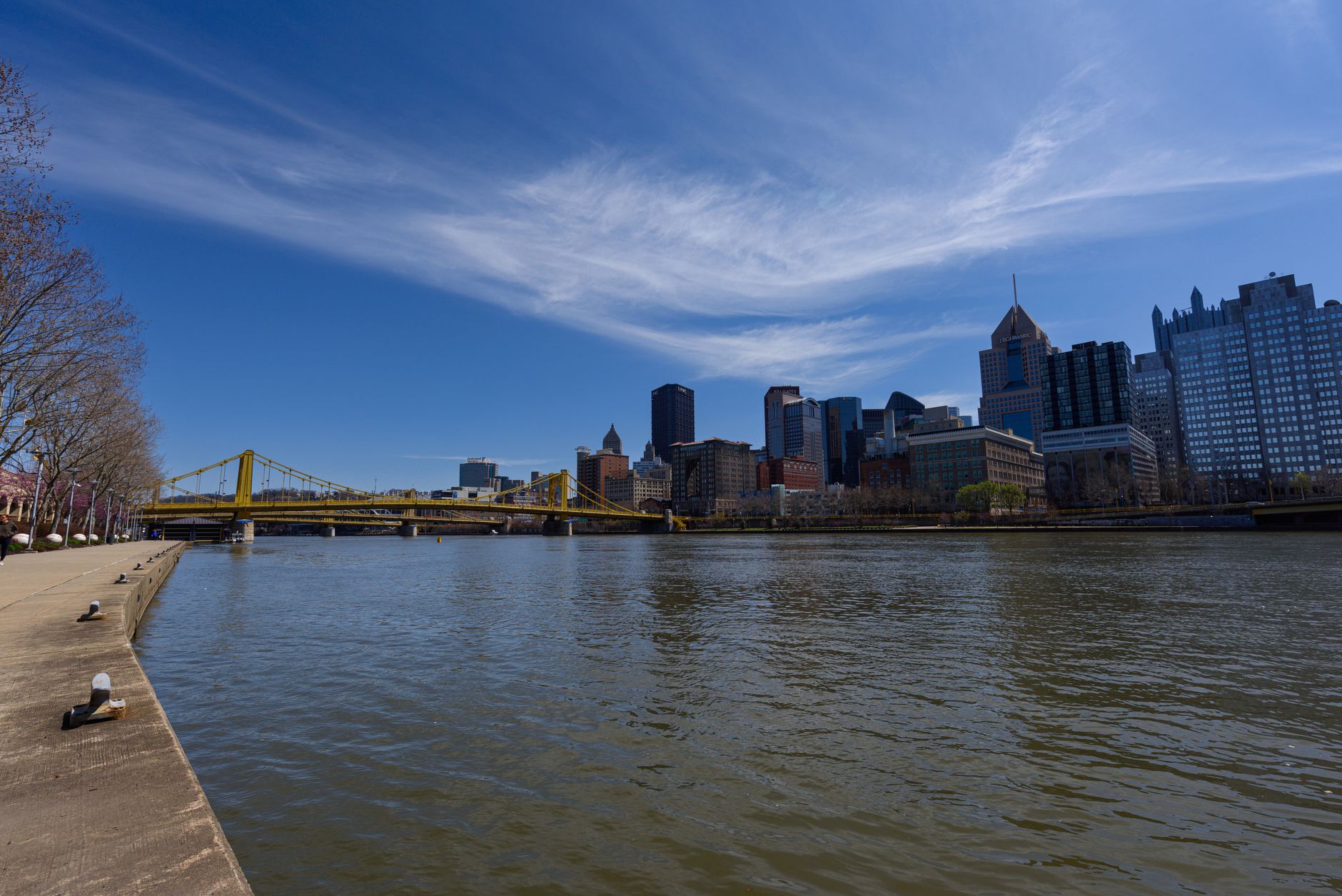
Pittsburgh, with 300,000 people in the city proper and 2.4 million in the metro, operates on a different scale. That can be a feature. People who live there often describe it as a city where you can have a neighborhood identity — where you're from Squirrel Hill or South Side or Lawrenceville — in a way that doesn't happen in larger cities where neighborhoods blur into each other. The restaurant scene punches above its weight. The cost of going out is lower. The commute is shorter. And Pittsburgh's topography — the three rivers, the hills, the views from Mount Washington looking back at Downtown — gives the city a physical drama that few American cities can match.
Weather: Both Cold, Pittsburgh Grayer
Philadelphia has genuine winters — January lows around 24°F, occasional snowstorms — but it's a few degrees milder than Pittsburgh and sits far enough south that winter's grip loosens earlier in the spring. Summers are hot and humid (mid-80s, high humidity in July and August), but the proximity to the Jersey Shore gives Philadelphians a meaningful escape valve.
Pittsburgh is colder and, more distinctly, far cloudier. The city averages only about 59 sunny days per year — making it one of the cloudiest major cities in the continental United States, trailing only famously gray places like Seattle and Buffalo. January lows average around 19°F. The weather is rarely severe in a dramatic way, but the persistent overcast from October through March is something residents mention consistently. If you're sensitive to gray skies, it matters.
Neighborhoods
Philadelphia neighborhoods to know: Rittenhouse Square is the city's most polished urban address — walkable, leafy, expensive. Fishtown and Northern Liberties are where young professionals landed when Center City got too expensive; both have strong restaurant and bar scenes. Society Hill and Old City preserve colonial Philadelphia in a way that's genuinely impressive and livable. The Main Line suburbs are the family corridor — Ardmore, Wayne, Haverford, great schools, commuter rail access, expensive. South Philly is working-class Italian-American heritage meeting a new generation of restaurants and row-house renovations.
Pittsburgh neighborhoods to know: Shadyside is the closest Pittsburgh has to Rittenhouse — walkable, expensive by local standards, boutiques and cafes on Walnut Street. Squirrel Hill is a historic Jewish neighborhood with excellent restaurants and a strong community identity. Lawrenceville is the Fishtown equivalent: former working-class neighborhood now full of galleries, craft breweries, and competitive brunch spots. South Side has the bar scene, the late nights, the sports crowd after games. Mount Washington isn't really a neighborhood you commute from easily, but the views from the Grandview Avenue overlook are the best thing in Pennsylvania.
Getting Around
Philadelphia's transit is one of its genuine advantages. SEPTA runs a subway, elevated rail, extensive bus network, and regional rail that reaches far into the suburbs. You can live in Philadelphia and not own a car — it's not New York, but it's legitimately transit-accessible in a way that most American cities aren't. The Amtrak connection to New York (90 minutes on the Acela) and Washington D.C. (also 90 minutes) amplifies the advantage.
Pittsburgh's transit is functional but limited. The bus network covers the city reasonably well, and a single light rail line runs from Downtown through the South Hills suburbs. But for most people in most neighborhoods, Pittsburgh requires a car. The geography — hills, rivers, bridges — actually makes Pittsburgh's traffic more complicated than its size would suggest, and certain corridors (Forbes Avenue, Penn Avenue) congest meaningfully at rush hour.
Sports Culture
Both cities are among the most sports-obsessed in the country. Philadelphia has the Eagles (NFL), Phillies (MLB), 76ers (NBA), and Flyers (NHL) — and a fan culture that is legendarily intense, occasionally crossing into hostile. The 2008 Phillies World Series and the 2018 Eagles Super Bowl win are events that Philadelphians date their lives around. Pittsburgh has the Steelers (NFL), Pirates (MLB), and Penguins (NHL) — with arguably the most storied football franchise in the sport's history, and a fan base that is passionate in a way that's warmer and slightly less intimidating than Philadelphia's.
The Verdict
Move to Philadelphia if: you want major-city scale — the density, the transit, the cultural institutions, the sheer variety of neighborhoods — or you work in pharma, media, or financial services and want to be in the corporate ecosystem. The NYC proximity is a genuine lifestyle asset that Pittsburgh can't replicate. Be prepared for the city wage tax and for housing in good neighborhoods that costs more than Pittsburgh's equivalent.
Move to Pittsburgh if: affordability is a genuine priority and you want to own a home without overextending, you're in tech or healthcare or an AI-adjacent field, or you want a city that operates at a more human scale without sacrificing quality of restaurants, culture, or community. The cloudiness is real and worth knowing about going in. The rest of the tradeoff is mostly in your favor.
For neighborhood-level data on both cities — safety, schools, walkability, home prices — the WYLT reports for Philadelphia, PA and Pittsburgh, PA pull real census and local data without the real estate spin.